A mechanical seal is a precision component that seals the gap between a rotating shaft and its housing in equipment such as pumps, mixers and compressors. A rotating face, keyed to the shaft, is pressed by spring load against a stationary face fixed to the housing, and the microscopically thin fluid film between the two faces provides lubrication and sealing at the same time.
Compared with a conventional lip seal (oil seal), a mechanical seal minimizes leakage even under high pressure and high-speed rotation, making it widely used in rotating equipment handling demanding fluids such as crude oil, chemicals and seawater. POLY STAR supplies mechanical seals in configurations ranging from standard to cartridge-style, matched to your operating conditions.
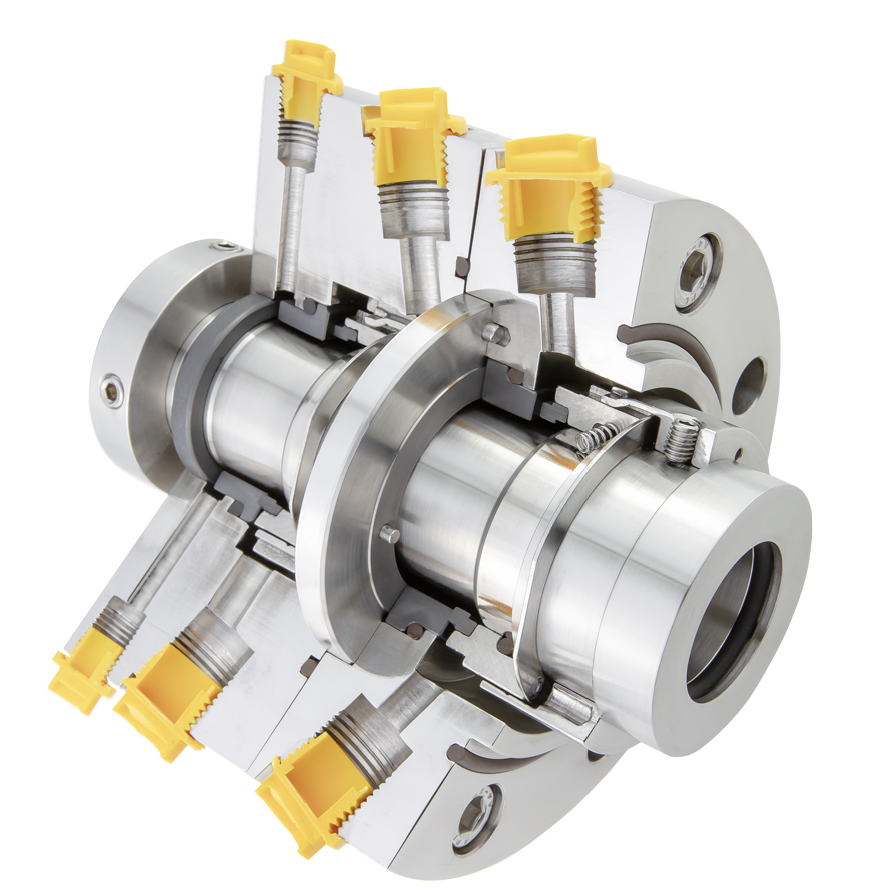
The rotating and stationary faces are lapped to an extremely fine, flat finish, so the microscopically thin fluid film between them handles both lubrication and sealing. O-rings or gaskets provide secondary sealing between each face and the shaft or housing, while a spring (or bellows) compensates for face wear to keep contact pressure stable. Face materials are chosen for the duty — very hard combinations such as silicon carbide are used where sand or water contaminate the fluid (crude oil, seawater), while chemically resistant materials are chosen for aggressive process fluids.
Precision-lapped stationary/rotating face contact minimizes leakage even under high pressure and high-speed rotation.
Silicon carbide (SiC) and tungsten carbide (WC) faces handle abrasive fluids containing sand or debris.
Cartridge configurations reduce alignment error and simplify field replacement.
Face and O-ring materials are matched to fluid type, temperature and rotating speed.
Can be designed to meet international standards such as API 682.
| Component | Standard Material | Options |
|---|---|---|
| Faces (stationary/rotating) | Carbon vs. Ceramic | Silicon Carbide (SiC), Tungsten Carbide (WC) |
| Secondary Seal (O-ring/gasket) | NBR | FKM (Viton®), EPDM, FFKM |
| Spring/Metal Parts | SUS304 | SUS316, Hastelloy |