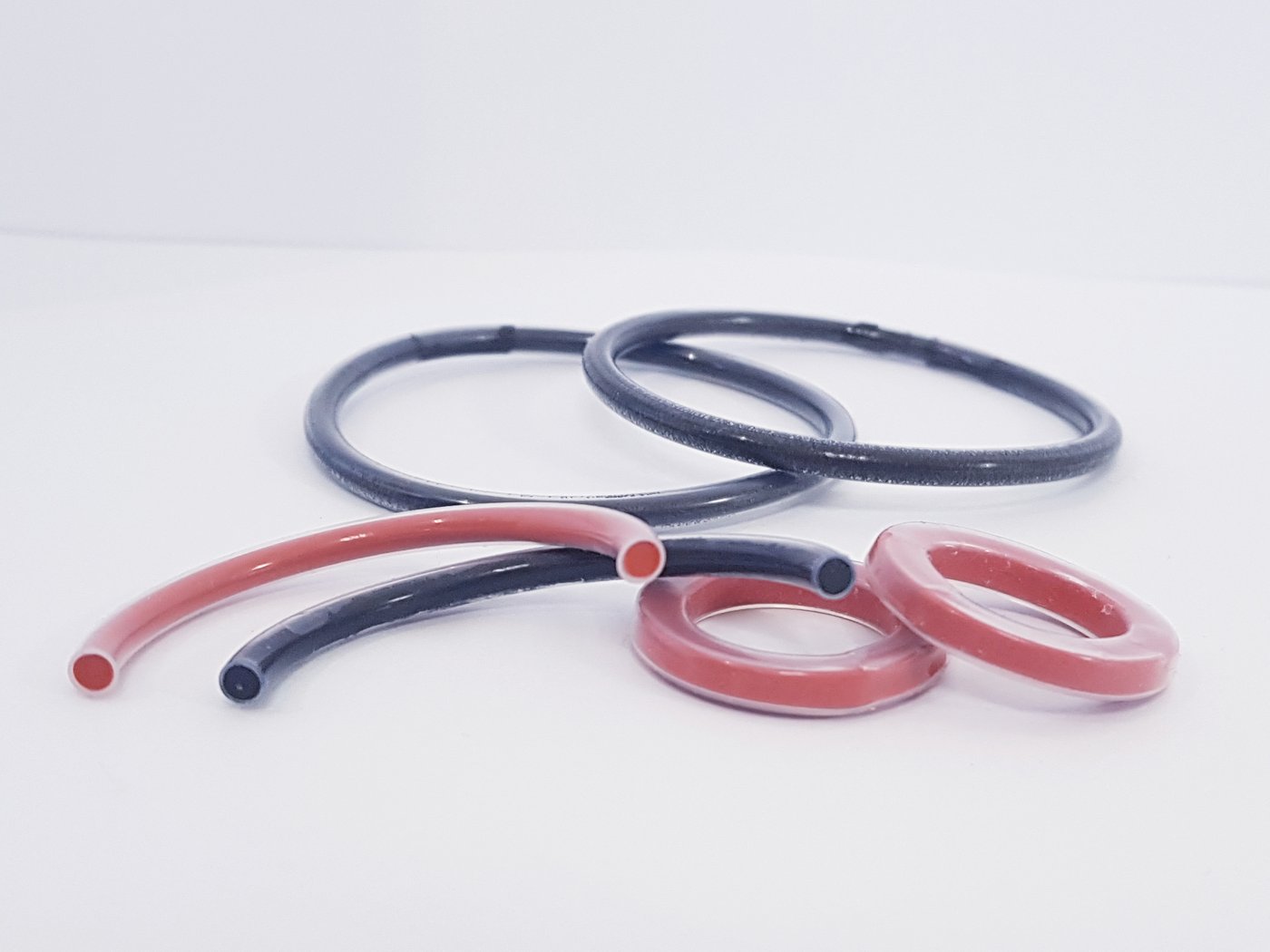
An elastomeric core wrapped in a seamless FEP or PFA jacket, minimizing direct contact between the process fluid and the core. Combines the chemical resistance of FEP/PFA with the recovery of an inner silicone or FKM core.
An elastomeric core is fully wrapped, seamlessly, in an FEP/PFA film so the process fluid's direct contact with the core is minimized. The wetted surface is handled by virtually chemically inert PTFE, while the inner core supplies compression and recovery. The elastomeric core offers better compression recovery than a solid PTFE ring, but generally requires higher installation load than a standard rubber O-ring and may have limits under repeated dynamic motion.
· FEP Encapsulation: a standard material suitable for many applications, offering good chemical resistance and a smooth capsule surface achieved through excellent heat-moulding bonding (up to approx. 205°C* based on the jacket resin).
· PFA Encapsulation: similar performance to FEP; PFA can be prioritized for conditions expecting higher temperatures and repeated deformation (up to approx. 260°C* based on the jacket resin).
*Reference values based on the jacket resin only — the seal's actual allowable temperature depends on the silicone/FKM core, pressure, fluid, and operating time.
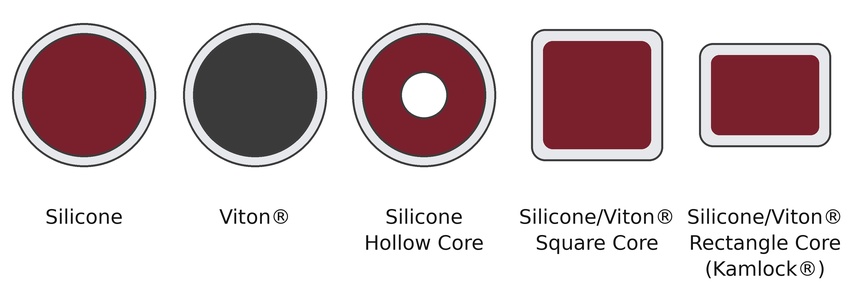
| Core Type | Characteristics |
|---|---|
| Silicone Inner Core | An excellent material for most applications, with lower hardness and higher elasticity than Viton®. |
| Viton® Inner Core | Offers better chemical resistance than silicone, holding up better to chemicals if the encapsulation is damaged. |
| Silicone Hollow Core | Superior compressibility versus a standard silicone core, requiring less clamp load thanks to its flexibility. Ideal for fragile or sensitive materials such as glass or plastic. |
| Silicone/Viton® Square/Rectangle Core | Designed as a gasket seal. The rectangular profile in particular is also used as a gasket for Camlock-style hose couplings. |
Strong chemical resistance — PFA/FEP offer strong resistance to a wide range of corrosive fluids, but actual suitability should be confirmed against the specific fluid type, concentration, temperature, and permeation potential.
Low-friction surface — the smooth PTFE surface reduces wear and extends service life.
Wide temperature range — as jacket-resin reference values, FEP up to approx. 205°C and PFA up to approx. 260°C, though actual allowable temperature depends on the core material, pressure, and fluid.